
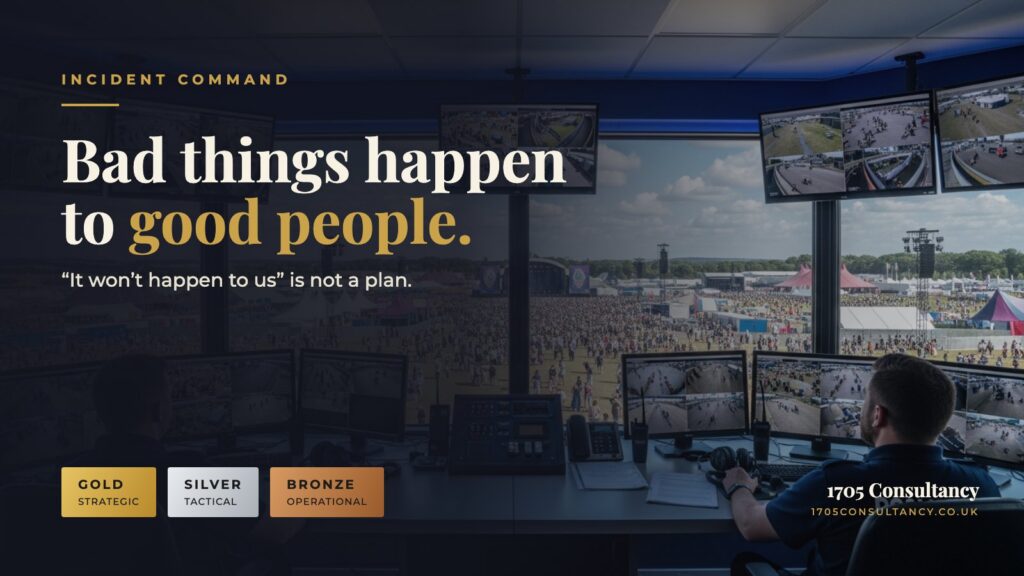
Bad things happen to good people. I learned that early in policing, and I was reminded of it on almost every shift for twenty three years. The family who did everything right and still lost someone. The venue manager whose emergency plan sat in a folder nobody had read. The supervisor who froze, not because they did not care, but because nobody had ever shown them what to do in the first five minutes.
None of those people were careless. Most of them were decent, conscientious and good at their jobs. What they had in common was a quiet assumption that the worst day would happen to someone else.
“It won’t happen to us”
I hear it in different forms every week. “We are only a small venue.” “We have never had a problem.” “The police will deal with it.” “We have a risk assessment.”
I understand why people say it. Planning for the worst is uncomfortable, it takes time and money, and on a normal Saturday it feels unnecessary. But every serious incident I have dealt with or reviewed started as a normal day for somebody. Nobody wakes up expecting a crowd crush, a fire, a structural collapse or an attack. That is the point.
The UK national threat level has been at severe since April, which means an attack is highly likely. Severe does not tell you where or when. It tells you that waiting is a decision, and not a safe one.
When it happens, structure is what saves you
In the first minutes of a serious incident, everything competes for attention. Radios are busy. People are frightened. Information is incomplete and often wrong. Someone has to take control, and everyone else needs to know who that is.
That is why the emergency services use the Gold, Silver and Bronze command structure, and why it works just as well for venues, events, retail sites, campuses and corporate estates.
Bronze is operational. The person on the ground, close to the problem, making things happen. Declaring the incident, passing a clear METHANE report, putting cordons in, moving people and making the evacuate, invacuate or lockdown call.
Silver is tactical. The person who sees the whole picture, coordinates several Bronze commanders, allocates resources that are never quite enough, and works alongside the police, fire and ambulance commanders when they arrive.
Gold is strategic. The senior leader who sets the aim, protects people and the organisation, speaks for it, and makes decisions that will be examined long after the incident is over.
When those three roles are clear, people stop waiting to be told what to do. When they are not, you see the same failures again and again.
The same lessons, every inquiry
Read any major UK incident inquiry and the findings feel familiar. Nobody clearly took command. Information did not reach the people who needed it. The agencies involved did not share a common picture. Decisions were made but not recorded, so nobody could later explain why.
The Manchester Arena Inquiry set this out in painful detail, including failures in communication and joint working between the organisations that responded. None of it was about a lack of courage. It was about structure, training and rehearsal.
Your organisation will not be judged as if it were the emergency services. But if something happens on your premises, you will be asked what you did, when you did it and why. Under Martyn’s Law, with its duties expected to come into force in spring 2027, those questions will carry legal weight as well as moral weight.
Understanding the roles is not just for commanders
Command is not only for the people with the title. Security officers, stewards, control room staff, duty managers and event safety teams all work inside this structure whether they realise it or not.
When a steward understands what Bronze needs from them, information flows. When a duty manager understands what Silver is trying to achieve, the priorities make sense. When a director understands Gold, the people below them are not left guessing.
The same applies to planning. An emergency plan written without a clear command structure is a document, not a response. The roles should be named in the plan, tested in exercises and understood by everyone who will be on shift.
How 1705 Consultancy trains command
Our command courses are exercise led, delivered in person by former police, fire and ambulance commanders, and built around the decisions you will actually face.
Bronze Commander. Two days for supervisors, duty managers, control room staff and anyone who may have to take charge on the ground. You will declare and run an incident using JESIP, METHANE and CSCATTT through two assessed live exercises, a structural collapse at a busy venue and a marauding terrorist attack through to police handover. No blue light background is needed.
Silver Commander. Two days for experienced managers who lead the response. One continuous scenario, more than one incident competing for the same resources, a decision log audit, a witness statement and an inquiry style panel where you explain your own decisions.
Strategic (Gold) Crisis Command. Two days for chief executives, directors and Martyn’s Law designated senior individuals. Setting a strategic aim in the first hour, leading a gold group, working with the emergency services at strategic level and facing a live press conference.
For wider teams we also run half day JESIP for Events and Venues and Decision Logging and Loggist Training, and we can build a tabletop or live exercise around your own site. You can see the full command pathway on our incident command training page.
A final thought
I have sat with families after the worst day of their lives. Not one of them cared what the policy said. They wanted to know that the people responsible had done everything they could.
Bad things happen to good people. The only question is whether the good people in charge were ready.
If you would like to talk about command training for your team, or a bespoke exercise built around your venue or event, get in touch for an informal conversation. We will tell you honestly what you need, and what you do not.