
Truro City Council has cancelled its Bonfire Night fireworks for the second year running. This year’s display was due to be ticketed, for up to 5,000 people. The town clerk said the council could not keep the entry price affordable and still meet “the necessary requirements of an ‘enhanced tier’ event under Martyn’s Law.”
I am not going to criticise Truro for that. The council looked at safety, money and staff and made a call. If you cannot run an event safely you should not run it.
What concerns me is how the story has been retold since. The version doing the rounds is “Martyn’s Law means we can’t do fireworks any more.” It doesn’t. Before more councils and community groups pull their events I want to set out what the law actually says.
The duties are not in force this November
The Terrorism (Protection of Premises) Act 2025 got Royal Assent on 3 April 2025 with an implementation period of at least 24 months. The SIA expects the duties to start in spring 2027 and will confirm the exact date. The statutory guidance is clear. There is no legal requirement to comply until the duties come into force.
So none of Martyn’s Law’s duties apply to a fireworks display this year. Your normal duties do. Health and safety law, fire safety law and your licence conditions if you have one. Those have always been there.
Getting ready early is sensible. Cancelling because of a duty that has not started yet is a different decision and you need the facts in front of you before you make it.
Are you actually in scope?
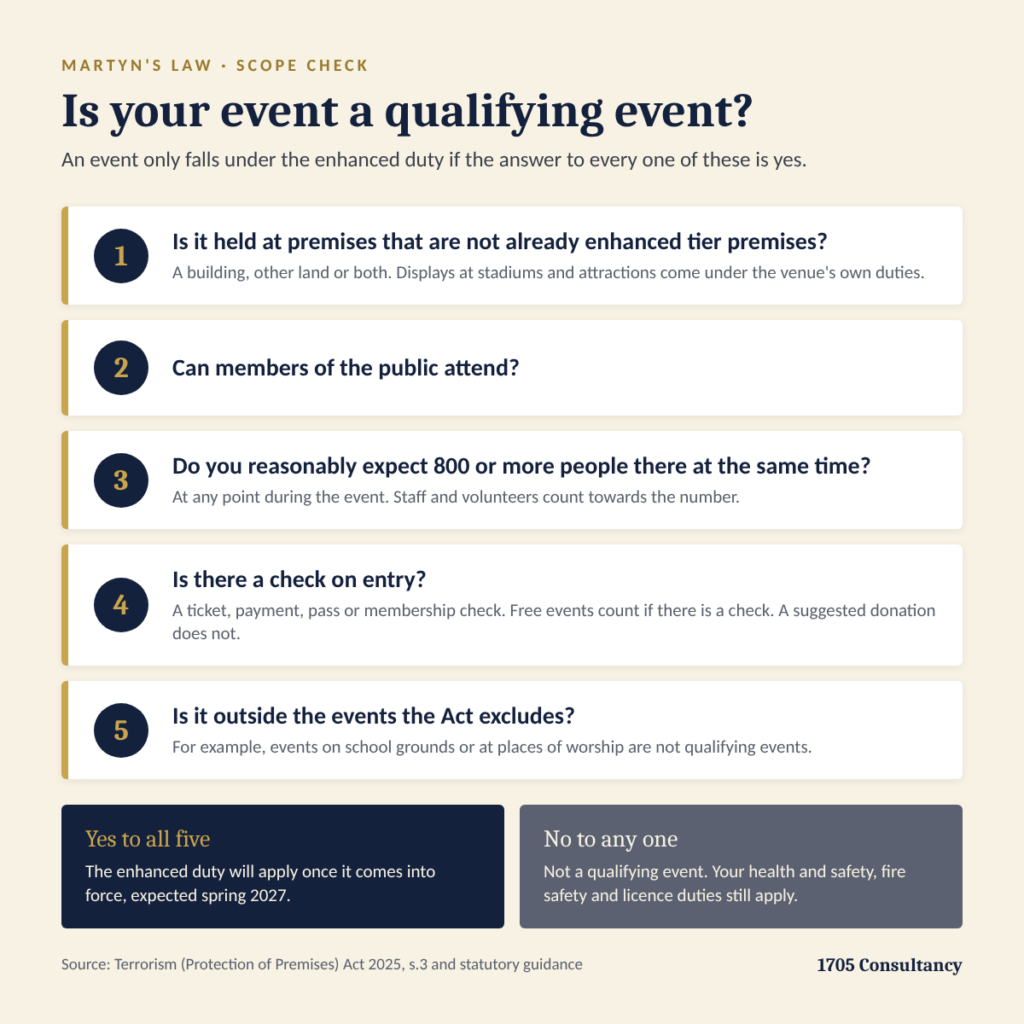
When the Act does come in, an event only falls under the enhanced duty as a “qualifying event” if every one of these is true.
- It is held at premises (a building, other land or both) that are not already enhanced tier premises.
- The public can attend.
- You can reasonably expect 800 or more people there at the same time at some point. Staff count towards that number.
- There is a check on entry, such as a ticket, payment, pass or membership check.
- It is not one of the events the Act excludes.
The guidance splits these into six criteria but the effect is the same.
The entry check is the one people miss. It covers free events as well as paid ones if there is a specific check on the way in. A suggested donation does not count. A free open display on a public field with no entry check anywhere on site is not a qualifying event.
There are catches. A ticketed or wristbanded enclosure expecting 800 or more people can be a qualifying event on its own. A display at a stadium, attraction or other venue already covered by the Act comes under that venue’s duties. An event on school grounds or at a place of worship is not a qualifying event, although the school or church may have standard tier duties of its own.
And please do not drop ticketing just to stay out of scope. Ticketing is one of the best crowd management tools you have. You know how many people are coming, you can control numbers and you can talk to them before and during the event. Losing that to avoid some paperwork makes the event less safe.
Enhanced tier is not a ring of steel
If your event is in scope, the person responsible for it has five things to do. The Act means whoever controls the site for the event, which is not always the organiser.
- Tell the SIA they are responsible for the event.
- Have procedures for evacuation, moving people to safety, stopping people coming in or going out and telling people what is happening.
- Assess, put in place and keep under review measures that reduce the event’s vulnerability to an attack and the harm if one happens.
- Write it all down in a compliance document and send a copy to the SIA.
- If the responsible person is an organisation, a council for example, name a senior individual to oversee compliance.
Procedures and measures are both “so far as is reasonably practicable”. That phrase matters. The guidance says it means suitable and proportionate, weighed against cost, time and difficulty. It also accepts that money and staffing are relevant. Nobody expects a town council to protect a fireworks display the way a stadium protects a cup final.
The measures cover four areas. Monitoring the site and the area around it. How people move. The physical safety and security of the site. Keeping sensitive information about your plans secure.
Now think about a good fireworks display. Stewards who have been briefed and are watching the crowd and the edges of the site. Routes in and out that are kept clear. Site plans that are not on Facebook. A plan to stop the show and move people away from danger or hold them where they are. A control point with decent radios and a direct line to the police.
Most of that should already be in your event management plan.
Where I would start
If you are running a display this year or next, these are the questions I would ask.
Will you be in scope in 2027? Count your peak numbers honestly with staff and volunteers included. Then look at how people get in. The SIA says an online scope check tool is coming in the new year. ProtectUK already has a flowchart for events.
What does your current plan already cover? Put it against the four areas above. The gaps are usually smaller than people fear.
Do your stewards know what to look for and what to do? Awareness training like the Level 2 Award in Counter Terrorism Protective Security Awareness costs far less than physical measures and is often one of the most effective things you can do.
Have you tested it? An afternoon round a table with your key people will tell you more than another draft of the plan.
Who can share the load? Neighbouring councils, business improvement districts and local partners all want events to go ahead safely.
One more thing from Truro. When the council cancelled in 2025, for reasons that had nothing to do with Martyn’s Law, it pointed out that cancellations elsewhere in the area would have pushed more people to its own display than it could safely handle. People do not stop wanting fireworks because one display goes. They go to the next town or they set off their own in the back garden.
Ready, not cancelled
I did twenty three years in policing and this year I have worked on events of up to 20,000 people. The best run events I have seen were not the ones that spent the most on barriers. They were the ones where the organisers knew their site, knew their crowd and had practised what to do when it went wrong.
Martyn’s Law came out of the Manchester Arena attack. It was never meant to take away the events that bring a town together. It was meant to make sure the people running them are ready.
Ready to Protect the People In Your Care?
If you are planning a fireworks display, Christmas event or festival and want to know where you stand, our Event Readiness Check is a good place to start. We also provide event support, risk assessments and practical Martyn’s Law support.
Get in touch for an informal conversation. We will tell you honestly what you need and what you do not.
Does Martyn's Law apply to you?
Take our free five minute Martyn's Law Readiness Check. Find out your tier, who is legally responsible and what you need to do, with a personalised report referenced to the Act.