
Across the UK, businesses, venues and event organisers are still waiting.
Waiting for more guidance. Waiting for enforcement details. Waiting for budgets. Waiting to see what others do first.
The problem is that incidents do not wait.
Martyn’s Law is no longer a future conversation. The direction of travel is now clear and organisations delaying preparation may already be behind where they should be.
What many businesses are now realising is this is not simply about terrorism legislation. It is about governance, accountability, communication, preparedness and defensibility.
If something serious happened tomorrow, could you confidently explain what preparations were in place and how your staff would respond?
That is the real test.
Throughout my policing career, operational debriefs nearly always exposed the same underlying problems when incidents or operations struggled.
Communication failures.
Staff not understanding roles.
Poor information sharing.
People waiting for direction instead of making decisions.
Even seemingly small issues such as overtime codes being wrong, poor welfare arrangements or not enough food for staff often revealed wider planning and leadership failures underneath.
The same principles apply to businesses, venues and events today.
Many organisations still have plans which exist purely on paper. Policies nobody has exercised. Lockdown procedures staff have never practised. Emergency communication systems which have never been realistically tested under pressure.
A plan is only useful if people understand it during stress, uncertainty and confusion.
That is why realistic desktop exercises, drills and scenario training matter so much.
One phrase often used within policing and emergency planning is “doomed to succeed”.
Exercises where nobody wants failure exposed. Exercises where communication problems are quietly corrected instead of challenged. Exercises where staff know the answers before it even starts.
But that completely misses the point.
The purpose of exercising is to identify weaknesses before a real incident does.
The uncomfortable exercises are usually the valuable ones. The ones where communication breaks down. The ones where assumptions get challenged. The ones where staff realise they are unsure what to do.
That is where resilience is actually built.
One of the biggest weaknesses we continue to see across businesses and venues is emergency communication.
When incidents occur people immediately seek information.
What is happening?
Where do we go?
Is it safe?
Do we evacuate or stay inside?
Without clear communication, confusion quickly fills the gap.
This is why businesses are increasingly recognising that preparedness cannot sit with a single person or isolated document. Effective preparedness requires a linked up, tested and professionally supported response structure.
Increasingly, organisations are moving towards retained support models which bring together specialist advice, communication planning, exercising, training, operational guidance and trusted partner support into one coordinated solution.
Not just for compliance purposes, but because incidents demand joined up responses.
Risk management, fire safety, medical provision, communication systems, operational leadership and staff preparedness should never operate in silos during a crisis.
The strongest organisations are now building preparedness ecosystems around their business which allow them to access ongoing professional support, realistic exercising, communication solutions and specialist expertise when they actually need it most.
Because the reality is simple.
During major incidents, organisations rarely rise perfectly to the occasion.
They usually fall back on the level of preparation already in place.
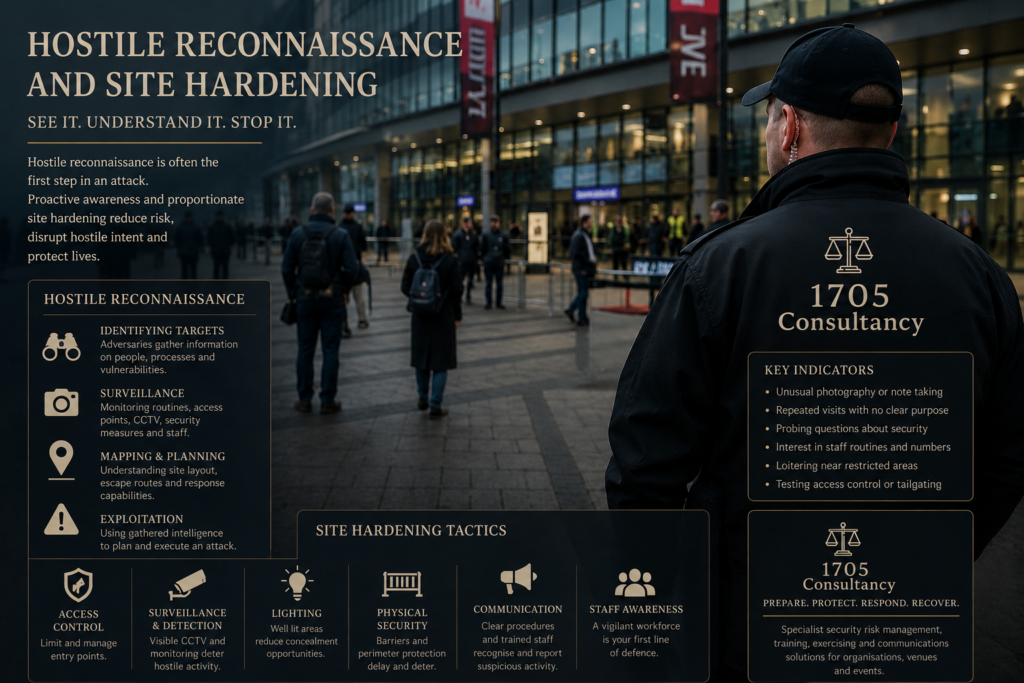
At 1705 Consultancy Ltd we support businesses, venues, schools and event organisers with proportionate preparedness solutions including risk assessments, desktop exercises, communication planning, training, drills and retained professional support designed to create practical and joined up resilience.
If you would like an honest conversation about your current preparedness and where the gaps may exist, get in touch with our team.